There are many intractable diseases in the world for which no cure has been found, as well as many difficult-to-cure diseases. Notably, research and development of therapeutic agents for infectious diseases such as malaria, tuberculosis, and NTDs, which are prevalent in developing countries, is not progressing due to unpromising marketability. Furthermore, inadequate medical systems, poverty, and disasters in developing countries prevent them from receiving needed medicines and medical services.
To address these issues of access to healthcare, the Group will leverage its strengths in drug discovery, and work in partnership with NPOs, NGOs, industry groups, and others based on our MISSION of “Creating hope for all facing illness.”
Working from our MISSION, “Creating hope for all facing illness,” we promote research and development into intractable and rare diseases, with the goal of offering new possibilities to patients with limited treatment options.
We have developed therapeutic drugs for intractable diseases such as inflammatory bowel disease and multiple sclerosis. Providing new options for diseases for which there is no cure is our MISSION itself. We are working to realize precision medicine for diseases for which unmet medical needs remain, especially in the central nervous system and immuno-inflammatory areas. In addition, we will contribute to improving the quality of life of patients and their families by providing solutions based on therapeutic drugs from prevention to prognosis.
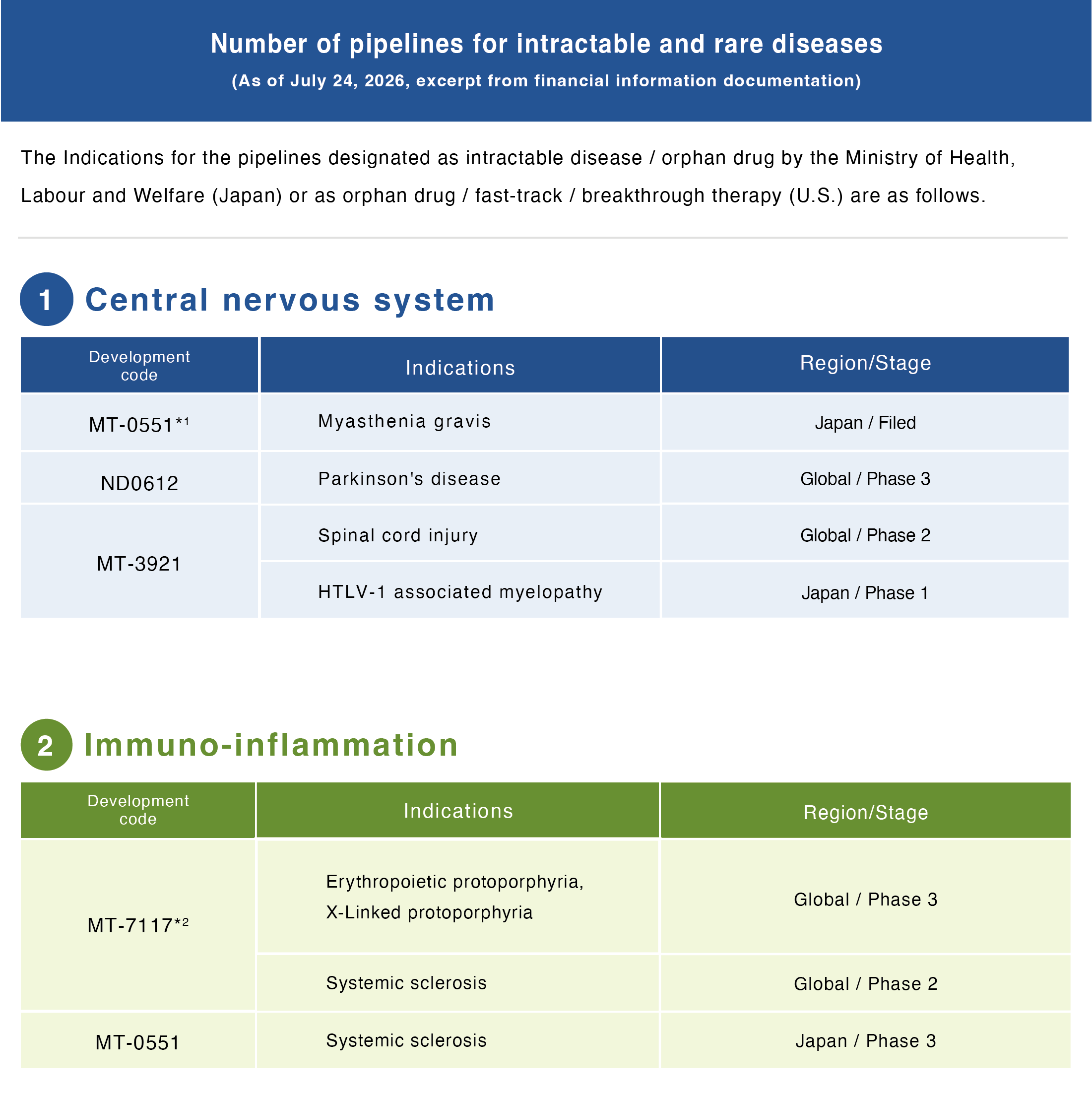
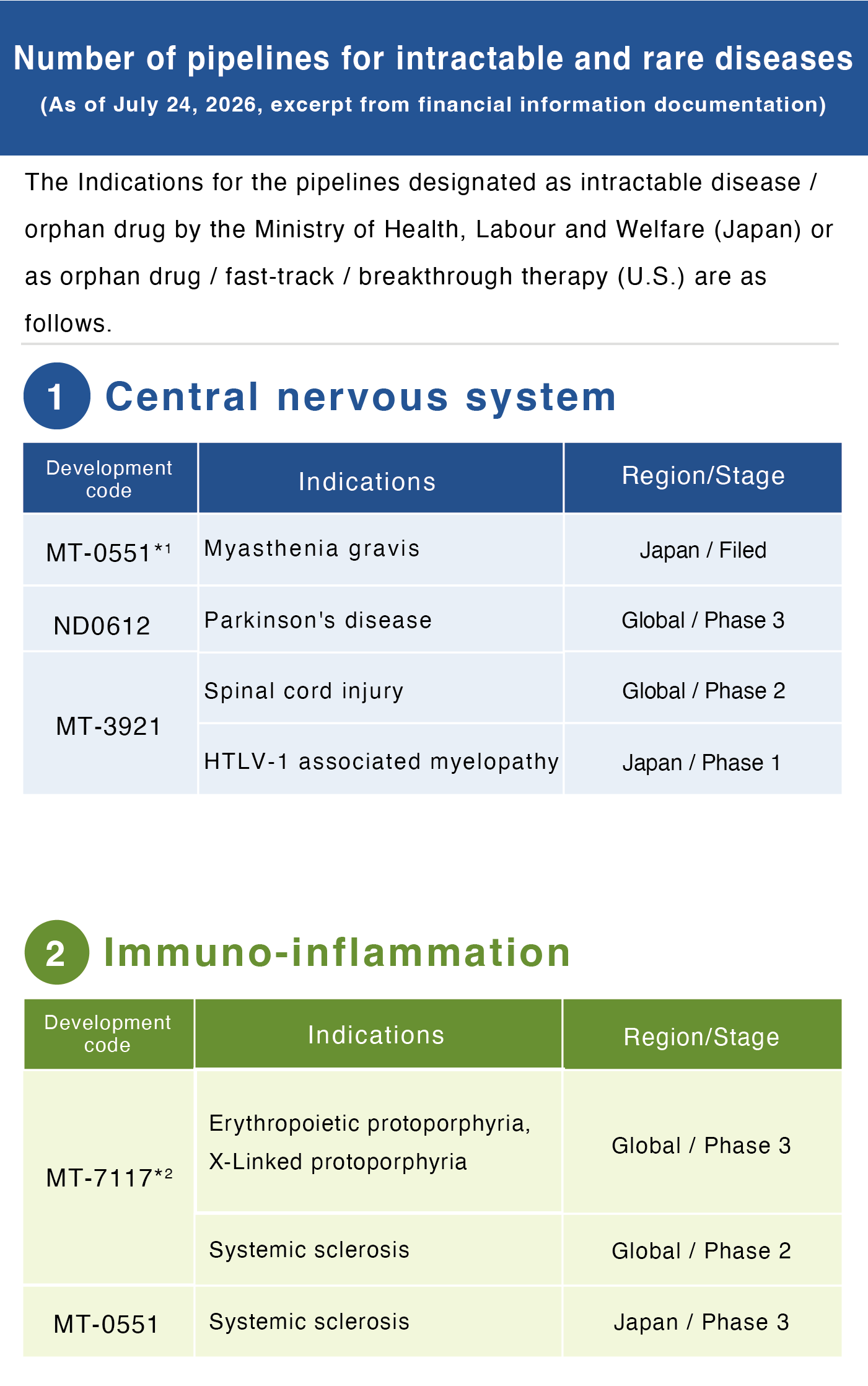
-
Tanabe Pharma Receives Approval in Japan for additional indication of generalized Myasthenia Gravis Anti-CD19 monoclonal antibody UPLIZNA® for I.V. Infusion 100 mg (announced September 16, 2026)
https://www.tanabe-pharma.com/en/news/rel_260916/main/0/link/e_rel_260916.pdf
-
Tanabe Pharma Enters into Agreement with LEO Pharma for MT-7117 for EPP and XLP (Announced August 18, 2026)
https://www.tanabe-pharma.com/en/news/rel_260818/main/0/link/e_rel_260818.pdf
Tanabe Pharma Enters into Agreement with LEO Pharma for MT-7117 for EPP and XLP (Announced September 18, 2026)
https://www.tanabe-pharma.com/en/news/rel_260918_2/main/0/link/e_rel260918_2.pdf
Dersimelagon is being developed as a new treatment option for erythropoietic protoporphyria and X-Linked protoporphyria, which cause painful skin symptoms when exposed to sunlight. In 2021, we began clinical trials of Dersimelagon as a treatment for systemic sclerosis, which is a rare disease and characterized by hardening of the skin and internal organs.
Going forward, we will work on research and development to attain our MISSION and contribute to the realization of a healthy and sustainable society by offering a promising option to a large number of patients around the world who are struggling with intractable diseases, as well as to their families.
Controlling infectious diseases that are prevalent in developing countries leads to improved living conditions for people and the overcoming of poverty, creating a virtuous cycle not only in developing countries but throughout the world. As a drug discovery company, we believe that leveraging our strengths in drug discovery is the best way to contribute, and we are conducting research on therapeutic drugs for infectious diseases through the GHIT Fund. We also provide various support through collaborative research efforts with non-profit organizations aimed at creating new antimicrobial medications for use against drug-resistant bacteria, and by paying attention to intellectual property in developing countries and donating to NPOs and NGOs.
The Global Health Innovative Technology Fund (GHIT Fund) is Japan’s first public-private partnership to promote the creation of innovative treatment agents for infectious diseases that affect people in developing countries, such as malaria, tuberculosis, and neglected tropical diseases (NTDs).
We support the GHIT Fund’s objective of contributing to global health, and financially support the fund. Meanwhile, with funding from the GHIT Foundation, we are researching with our partners infectious disease treatments that are widespread in developing countries.
In particular, the eradication of malaria and NTDs presented below is listed as one of the 169 targets linked to the 17 goals of the United Nations’ Sustainable Development Goals (SDGs).
Working through GHIT Fund initiatives, we promote research and development into treatments for infectious diseases in developing nations, helping improve access to healthcare by offering new treatment options to people who need them.
Malaria is one of the three most serious infectious diseases, killing approximately 600,000 people each year. Utilizing funding from the GHIT Fund, we collaborated with MMV, to start joint antimalarial drug research in December 2014, which featured a discovery screening program that succeeded in identifying promising hit compounds. In addition, we promoted joint research and from one of these compounds, we acquired two lead compounds as new anti-malaria drug candidates, and moved to the lead optimization stage in April 2019. Moreover, in October 2023, we acquired funding for further research from GHIT Fund, and with the University of Georgia as an additional partner, are continuing collaborative research to identify preclinical candidates.
WHO defines 21 diseases as Neglected Tropical Diseases (NTD) that humanity must control. In September 2019, we launched a collaboration supported by GHIT Fund for a discovery screening program with DNDi, which is dedicated to developing drugs for these diseases, and acquired a hit compound for one such neglected disease, Chagas disease. In April 2021, DNDi and we started a Hit to Lead (HL) study for Chagas disease to identify lead compounds and succeeded in generating a lead compound with promising efficacy in a preclinical Chagas model. From April 2024, we acquired funding for further research from GHIT Fund and began lead optimization research. Additionally, in fall 2023, the joint research project was awarded DNDi 2023 Project of the Year in Pre-Clinical Research.
DNDi Projects of the Year
Every year DNDi offers awards to teams and partners that have achieved significant results in projects conducting preclinical and clinical research. The DNDi Scientific Advisory Committee makes nominations from among more than 40 projects in DNDi’s R&D portfolio, and two of those nominated are selected for awards by Executive Board members from DNDi.
Headquartered in Switzerland, the non-profit Global Antibiotic Research and Development Partnership (GARDP) develops new medications for drug-resistant bacterial infections that pose a grave danger to our health. It was established in 2016 by the World Health Organization (WHO) and the Drugs for Neglected Diseases initiative (DNDi) to ensure that everyone who needs antimicrobial drugs has access to effective, affordable treatment.
In November 2022, we concluded a contract with GARDP to offer its screening compound library with the goal of developing new antimicrobial drugs for use against drug-resistant bacteria. This screening resulted in the successful identification of several types of hit compounds, and we are currently evaluating the potential for further joint research. Through these initiatives, we support GARDP efforts to address serious bacterial infections caused by drug-resistant bacteria.

Tanabe Pharma Group has established an intellectual property policy that forms the basis for providing new healthcare opportunities in order to appropriately protect and make effective use of its globally competitive intellectual property. On the other hand, in countries where serious economic problems make access to healthcare difficult, we need to consider enforcing our patent rights. The Group contributes to healthcare access in economically deprived areas around the world. Therefore, as a general rule, we do not enforce our patent rights in the Least Developed Countries (LDCs) stipulated by the United Nations.
Please see “Protection of Intellectual Property Rights” for details.
|
Support provided |
Description of initiatives |
Countries targeted |
|
Providing vaccines and school meals to children in developing countries |
Group employees have participated in vaccine support activities for children in developing countries, which are conducted by the NPO Japan Committee, Vaccines for the World’s Children (JCV). This is an international contribution activity wherein donated used books and other items are sold and the proceeds are donated to JCV and used to deliver vaccines to children in developing countries. Furthermore, at the employee cafeterias, we participate in TABLE FOR TWO (TFT), in which one meal is provided to a child in a developing country for each meal ordered by an employee from our healthy menu. This is a support program conducted by the NPO TABLE FOR TWO International. School meals that are provided through donations are expected not only to help solve hunger among children but also lead to gains in the children’s fundamental strength and help prevent disease. We are actively promoting these initiatives to help raise employee awareness. |
Myanmar, Laos, Uganda, Rwanda, etc. |
Please see “Contributions to Medical Care and Welfare” for details about these initiatives.