We are committed to continuing to provide society with safety and trust in pharmaceutical products.
See here for a message from the Head of Quality and Vigilance Division
In April 2020, we established the Quality & Vigilance (QV) Division to oversee product quality and safety globally. The QV Division has the following functions.
- Establish systems and frameworks to ensure the stable supply of high-quality products
- Conduct audits to ensure the reliability of research, development, and post-marketing activities
- Collect, analyze, report, and communicate safety information on released products and products in development
- Develop and implement post-marketing safety surveillance strategies
To ensure that our pharmaceuticals can be used by healthcare professionals and patients with peace of mind, the QV Division strives to maintain and improve our system of reliability assurance by complying with various laws and regulations, including the Law on Securing Quality, Efficacy and Safety of Products Including Pharmaceuticals and Medical Devices, GLP, GCP, GMP, GQP, GDP, GVP, and GPSP.
The Company appropriately collects and evaluates safety information obtained in Japan and overseas, and has established and maintains safety measures and systems for providing safety information, taking into account differences in regulatory and medical environments among countries. Through these efforts, we are promoting appropriate use of products and ensuring safety. Furthermore, we cooperate with quality departments and safety departments in each country to provide products that comply with the regulations there.
The Company will work to ensure the quality, effectiveness, and safety of pharmaceutical products by complying thoroughly with laws and regulations and maintaining and improving its reliability assurance system.
System to assure the reliability of drugs
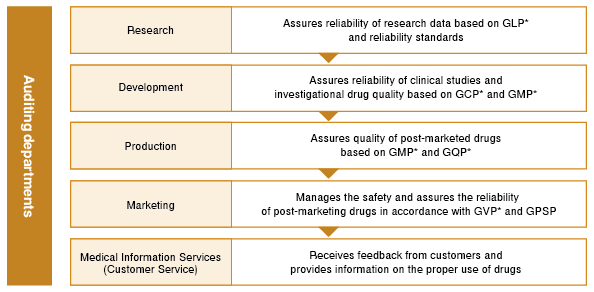
- Good Laboratory Practice (GLP)
Standards for conducting preclinical trials on pharmaceutical safety.
- Good Clinical Practice (GCP)
Standards for conducting clinical trials of pharmaceuticals.
- Good Manufacturing Practice (GMP)
Standards for manufacturing and quality control of pharmaceuticals and quasi-pharmaceuticals.
- Good Quality Practice (GQP)
Standards for quality control of pharmaceuticals, quasi-pharmaceuticals, cosmetics, and medical devices.
- Good Vigilance Practice (GVP)
Standards for post-manufacturing and marketing safety management of pharmaceuticals, quasi-pharmaceuticals, cosmetics, medical devices, and regenerative medical products.
- Good Post-marketing Study Practice (GPSP)
Standards for conducting post-marketing surveillance and studies of pharmaceuticals.
After the launch of a new drug, adverse drug reactions that were not discovered in clinical trials are sometimes reported. We quickly collect such information, analyze it, and provide feedback to healthcare professionals. We are moving forward with proactive safety management activities that incorporate new safety measures. We believe that these activities help minimize the risk and impact of adverse drug reactions from new drugs and promote appropriate usage by healthcare professionals.
Furthermore, healthcare practices and regulatory environments vary across countries, requiring safety management approaches tailored to local circumstances. It will therefore be necessary to exercise caution in safety management.
For example, edaravone, which was discovered by the Company, was approved in Japan in 2001 as a treatment for the acute ischemic stroke and has been in use for more than 20 years. Since 2015, edaravone has been used in Japan as well as overseas in countries such as the U.S. to treat ALS.
The abundant safety information that we have accumulated has given us valuable experience in promoting its proper use. Making full use of that experience, and taking into account the overseas regulatory and medical environments, we will work to collect and provide safety information to foster proper use and to contribute to improving patients' quality of life.
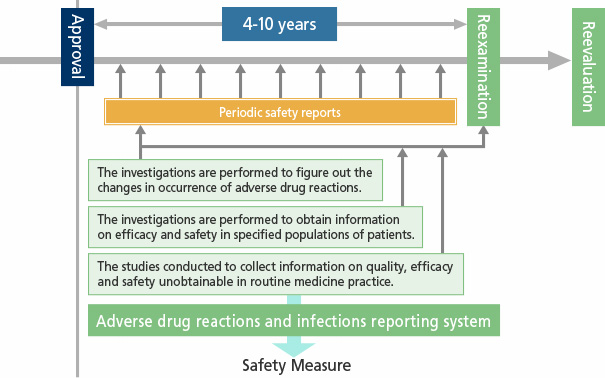
After the regulatory authority approves the manufacturing and marketing of a drug based on the results of nonclinical and clinical studies, we begin selling the drug. Clinical studies are conducted with the number of subjects that are required to scientifically verify the efficacy and safety of the new drugs. However, the conditions for participation in clinical studies (age, medical history, concomitant medications, etc.) are not necessarily the same as the post-marketing conditions of use.
Therefore, the Company starts to collect safety information under actual conditions of use at medical sites as soon as drugs are launched, and we also conduct various post-marketing surveillance. Through the surveillance, we aggregate safety information regarding the drugs that have been actually prescribed to patients, monitor the safety and efficacy of drugs, and promptly and accurately provide information obtained through the surveillance to regulatory authorities and healthcare professionals. In this way, we are seeking to support the proper use of drugs.
Post-marketing safety management and surveillance of safety in Japan
Our policy is to contribute to the health and well-being of people around the world through the stable supply of high-quality, reliable products which are manufactured under a world-class quality system. On that basis, we strictly comply with applicable GMP (standards for manufacturing and quality control of pharmaceuticals and quasi-pharmaceuticals) and GQP (standards for quality control of pharmaceuticals, quasi-pharmaceuticals, cosmetics, and medical devices) requirements. Patient safety is the first priority of every employee, and we are implementing initiatives targeting quality assurance with a focus not only on results but also on processes. Through management, supervision, and guidance of manufacturing sites in Japan and overseas, we are working to improve the quality of the products that we provide to the market.
Furthermore, we strive to ensure the quality of pharmaceuticals in accordance with a division notification from the Ministry of Health, Labour and Welfare dated June 1, 2016, regarding production based on the certificate of approval for manufacture and sales.
Above all, to ensure patient safety and prevent disadvantage, any problems found in the safety, effectiveness, quality, labeling, and other aspects of a product should be promptly reported to the regulatory authorities. Related information must also be provided to medical institutions, and a system should be in place to recall the product.
In fiscal 2025, there was one voluntary recall.
The Group positions ensuring pharmaceutical quality as one of its highest priorities and strives to provide pharmaceuticals that patients and healthcare professionals can use with peace of mind by complying with laws and regulations and continuously maintaining and improving reliability assurance systems.
Quality assurance initiatives
- Strengthen collaboration with manufacturing plants and reinforce checking systems, and regularly confirm actual manufacturing practices and the certificate of approval
- Enforce measures to prevent recurrence by rectifying and improving any defects based on our own checks and investigations at manufacturing plants
We are committed to accumulating and passing on knowledge, and raising awareness related to pharmaceutical safety for management and all employees.
In fiscal 2025, we also conducted educational training on pharmaceutical safety management and drug-induced suffering. As people who work at a pharmaceutical company, the training improved the risk sensitivity of each of us, so that we always act with high ethical standards, with the patient’s health and safety as our highest priority.