The Mitsubishi Tanabe Pharma Group works to prevent air, water, soil, noise, vibration, and odor pollution and each base sets stricter voluntary standards than the legal emissions standards for pollutants and applies them daily. Additionally, we have put goals in place for the prevention of environmental pollution for the Medium-Term Environmental Action Plan 21–25, and we are working to achieve them.
We also work to prevent the external leakage of PRTR substances and VOCs, which are regulated by laws, and to reduce the amount of these substances that are released into the environment.
The Group controls the generation of soot and smoke by reducing the operating time of fuel-driven boilers, water heaters and coolers, and power generators.
At our bases in Japan, we reduce the concentration of air pollutants in soot and smoke by mainly converting the fuel for these soot and smoke generating devices from oil to gas.
We have also enhanced measures to prevent environmental pollution in soot and smoke generating devices at our overseas bases by addressing the increasingly strict regulations of each country and improving and updating the devices as needed.
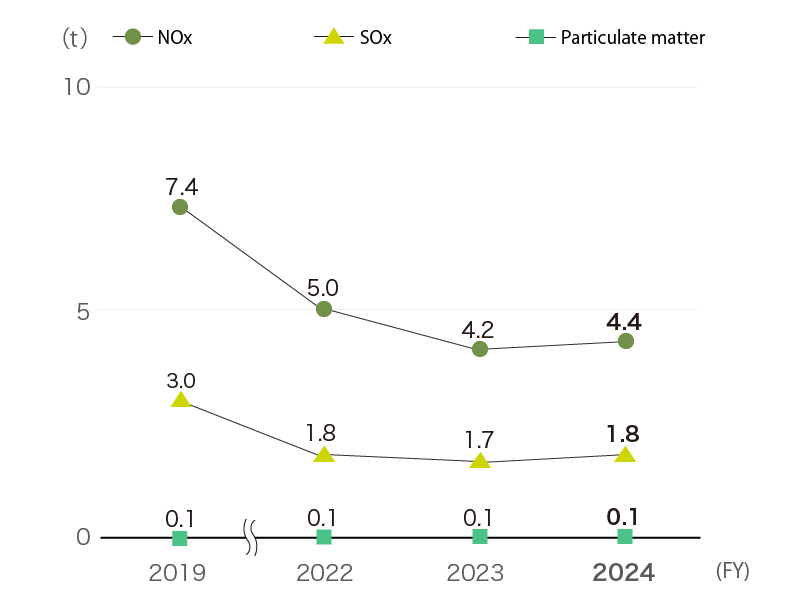
Emissions of air pollutants by bases in Japan
To the extent possible, harmful substances discharged from the Group’s production and research bases are treated as industrial waste on disposal to prevent contamination with wastewater.
Also, we adjust the pH of wastewater and purify it before discharge to comply with emission standards. Especially at Mitsubishi Tanabe Pharma Factory (the Onoda and Yoshitomi plants) and Mitsubishi Tanabe Pharma Indonesia (Bandung plant), where wastewater is discharged into public water bodies, activated sludge treatment is performed within factory grounds, and we comply with emission standards for public water bodies that are stricter than that for sewage discharge. At two plants in Japan, we constantly measure the pH, COD, nitrogen, and phosphorus of the wastewater, and when we detect an abnormality, we immediately stop its discharge and store it in a reserve water tank.
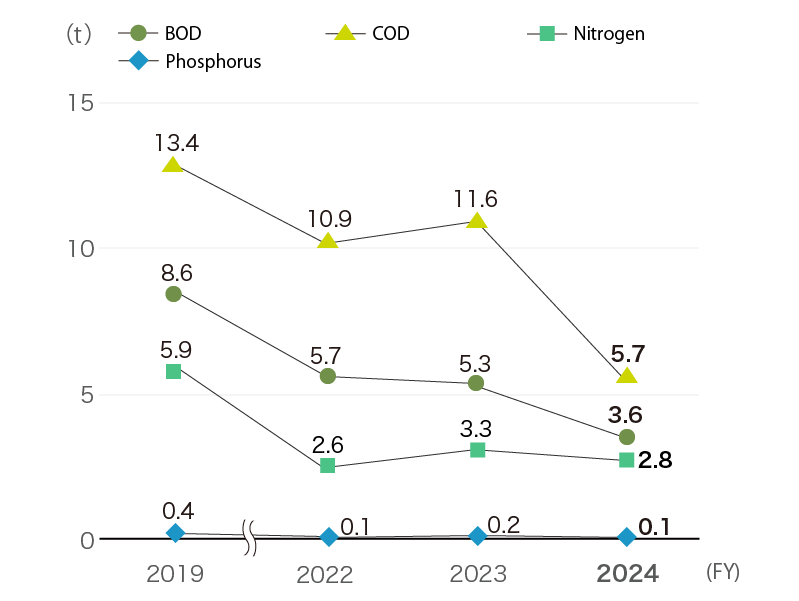
In fiscal 2024, COD volume in Japan was 5.7 tons, down 58% from fiscal 2019.
Environmental impact on public water bodies (Japan)
The Group conducts land use history surveys of bases in Japan where it owns land to identify soil contamination risk. To date, if surveys have found that the soil or groundwater is contaminated, we have notified the authorities and taken appropriate action. In fiscal 2024 there was a change in the soil quality at the Yoshitomi plant, and accordingly, we submitted a soil contamination survey and results report based on the Soil Contamination Countermeasures Act to the authorities.
At our bases in Japan, we monitor noise, vibration, and odor in accordance with related laws and regulations and confirm that they are within the established standards.
Based on the Law concerning Pollutant Release and Transfer Register/PRTR Law, the Group manages the amount of PRTR substances handled at our facilities and the emissions to the environment, and properly notifies the relevant regulatory authorities.
All organic waste solvents containing PRTR substances discharged from the research centers are treated as industrial waste to minimize the discharge to public water areas.
We are also studying the manufacturing processes and reducing the amount of target organic solvents used.
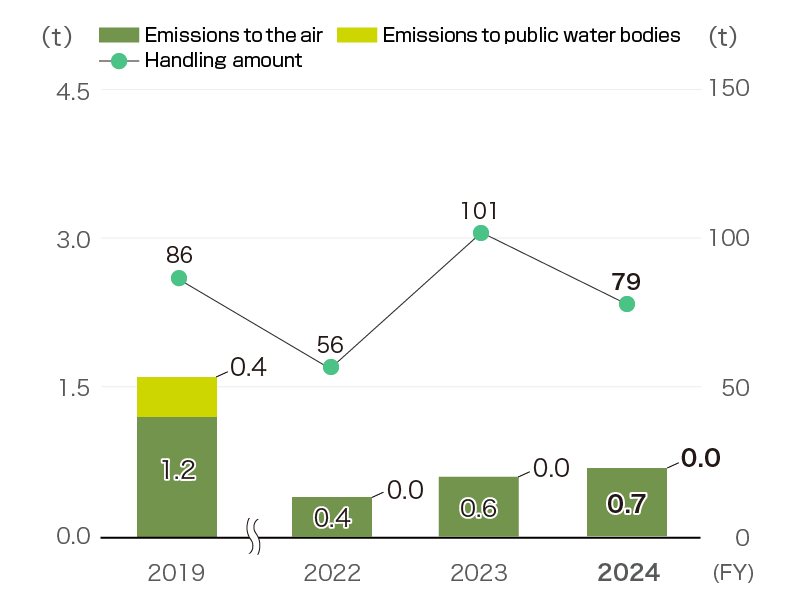
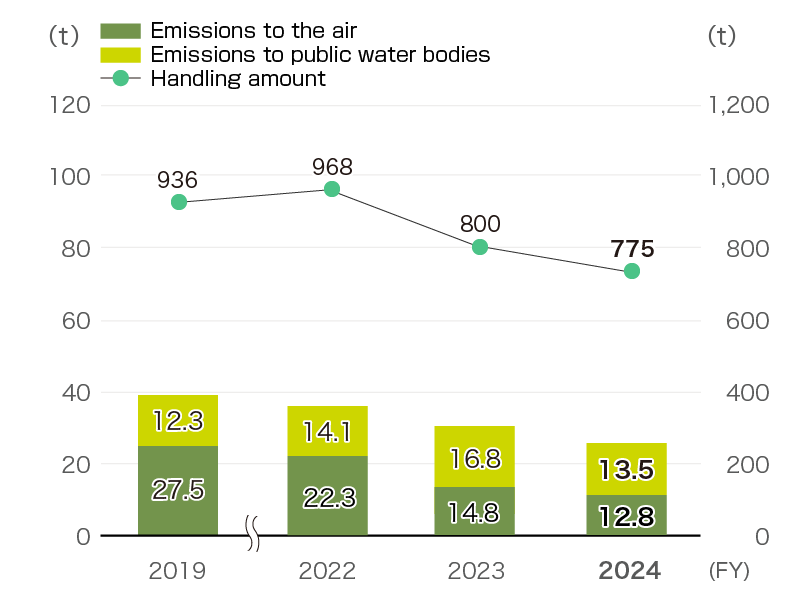
In fiscal 2024, emissions volumes of PRTR substances to both the air and to public water bodies in Japan totaled 0.7 tons, down 56% from fiscal 2019. We are reducing VOC emissions by managing emissions and the amount handled, setting up collection facilities, and reducing emissions into the natural environment.
Emission of PRTR substances (Japan)
Emission of VOC (excluding PRTR substances) (Japan)
We completed all disposal of high-concentration polychlorinated biphenyl (PCB) devices at the Group’s bases in Japan. Furthermore, we are conducting a confirmation survey of items with a low concentration of PCBs, including notification from the Ministry of Economy, Trade and Industry (March 31, 2022), and plan to move ahead steadily to complete disposal by March 31, 2027, the disposal deadline.
Surveys for sprayed asbestos have been conducted at Group bases in Japan in the past under the Ordinance on Prevention of Asbestos Hazards, and we are taking relevant measures to prevent asbestos scattering. Additionally, when demolishing or renovating buildings in association with business restructuring, we implement appropriate measures to comply with the law, such as checking for the presence of asbestos in the sprayed materials, insulation, and building materials to be moved, and reporting the results of these checks to the government.
The Group is engaged in drug discovery research aimed at various modalities, and opportunities to handle various research materials and samples are increasing. In the use of genetically modified organisms, we have established in-house regulations based on relevant government and ministerial ordinances, such as the “Law Concerning the Conservation and Sustainable Use of Biological Diversity through Regulations on the Use of Living Modified Organisms (Cartagena Act),” which we comply with. Moreover, the in-house Ethics Review Committee prevents the spread of living modified organisms by receiving preliminary reviews of measures to prevent the spread of these organisms into the environment.
In addition, regarding the use of pathogens and research materials and samples that may contain them, we have established internal regulations based on laws and regulations including the “Act on the Prevention of Infectious Diseases and Medical Care for Patients with Infectious Diseases (the Infectious Diseases Control Law)” and prevent the leakage of pathogens.
Note: Information on this page pertains to activities and results for fiscal 2024.